How Crossing
Author: Knut Sætrevik
Crossing is painstaking and time-consuming work that is preferably carried out in a greenhouse. First one must select a mother plant. On this plant one then chooses a portion of a cluster to use for the crossing. The rest of the cluster must be removed. Then one must keep watch for when the first cap on one of the flowers loosens. When this happens, this flower is removed and possibly other flowers that may have opened at the same time. This is done to prevent self-pollination. Now the cluster is ready so that one can remove the cap and the 5 stamens on all the other flowers with tweezers, without damaging the style. The plucked flowers are shielded from pollen with a bag, preferably a paper bag, until the style is mature and receptive to pollen. This can take 3-5 days. The style is ready for pollen when moisture shows at the tip of it. At this point one must have collected pollen from the variety that one has planned to use as the father. This can be done by shaking clusters from this variety up into a dry bag. Pollen can be collected some days ahead. One can make a small hole in the corner of the plastic bag and blow air into the bag. By pinching on the bag in bursts one will then pump an air stream with pollen toward the cluster on the mother plant. This can also be done with a fine brush. The cluster must then be covered with a bag again. This can be repeated several times over 2 to 3 days. After about a week one can see if the grapes are growing.
Figure: Crossing work.
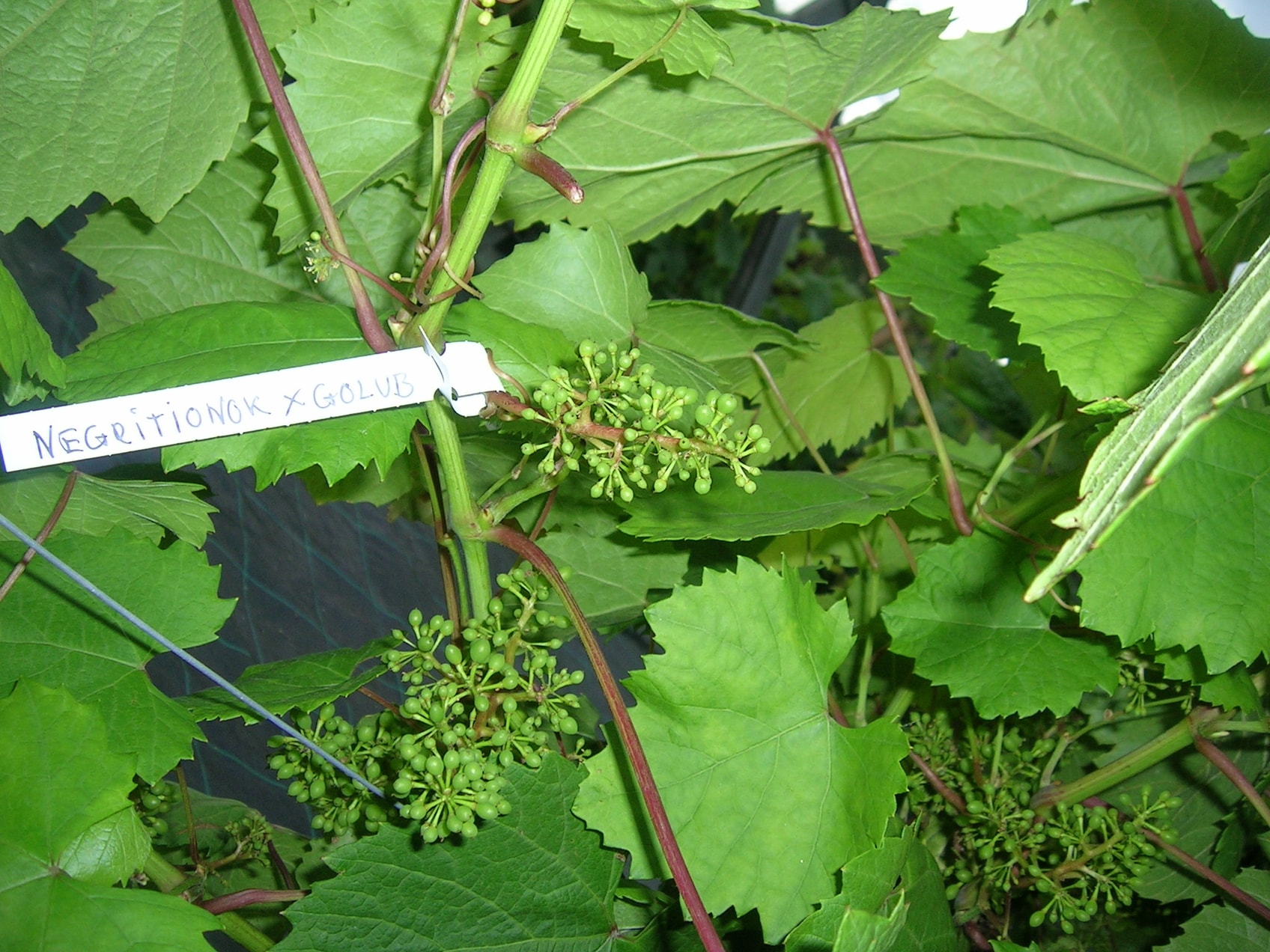
The photo is taken just after the grapes have begun to grow. After this the grapes must be allowed to grow and ripen until they have brown seeds. They can then be stored in the refrigerator until the coming winter or spring. They must be germinated in light soil with sand or perlite. It can take from 3 to 6 years before these plants are sexually mature. When the grapes finally arrive, it is not certain that the genes have distributed themselves in such a way that the new variety is any better than what we had as parents. Here in Norway it is important that genes that control short development time / development in limited temperature and hardiness against diseases are included. In addition, of course, traits such as good wine grape or table grape must also be present. Painstaking work yes, but incredibly exciting. On the pages of Cornell University/New York State Agricultural Experiment Station, you can read more about crossing: Cornell Grape Breeding